
Textile Electrodes with the K-Head
Embroidered electrodes for ECG, EMG, TENS and EMS. Learn how the K-head forms moss and chain stitch, which four parameters decide the result, how to prepare the machine for conductive yarn, how to design an electrode and how to fix stitch faults. With a printable handout and a final test.
-
9 lessons
Video training -
23 minutes
Total video time -
34 questions
Final test, pass mark 70 % -
499 €
One-time payment

Your trainer
Melanie Hörr
Co-Founder & Lead Development Engineer · 3E Smart Solutions
Electrodes that need no gel
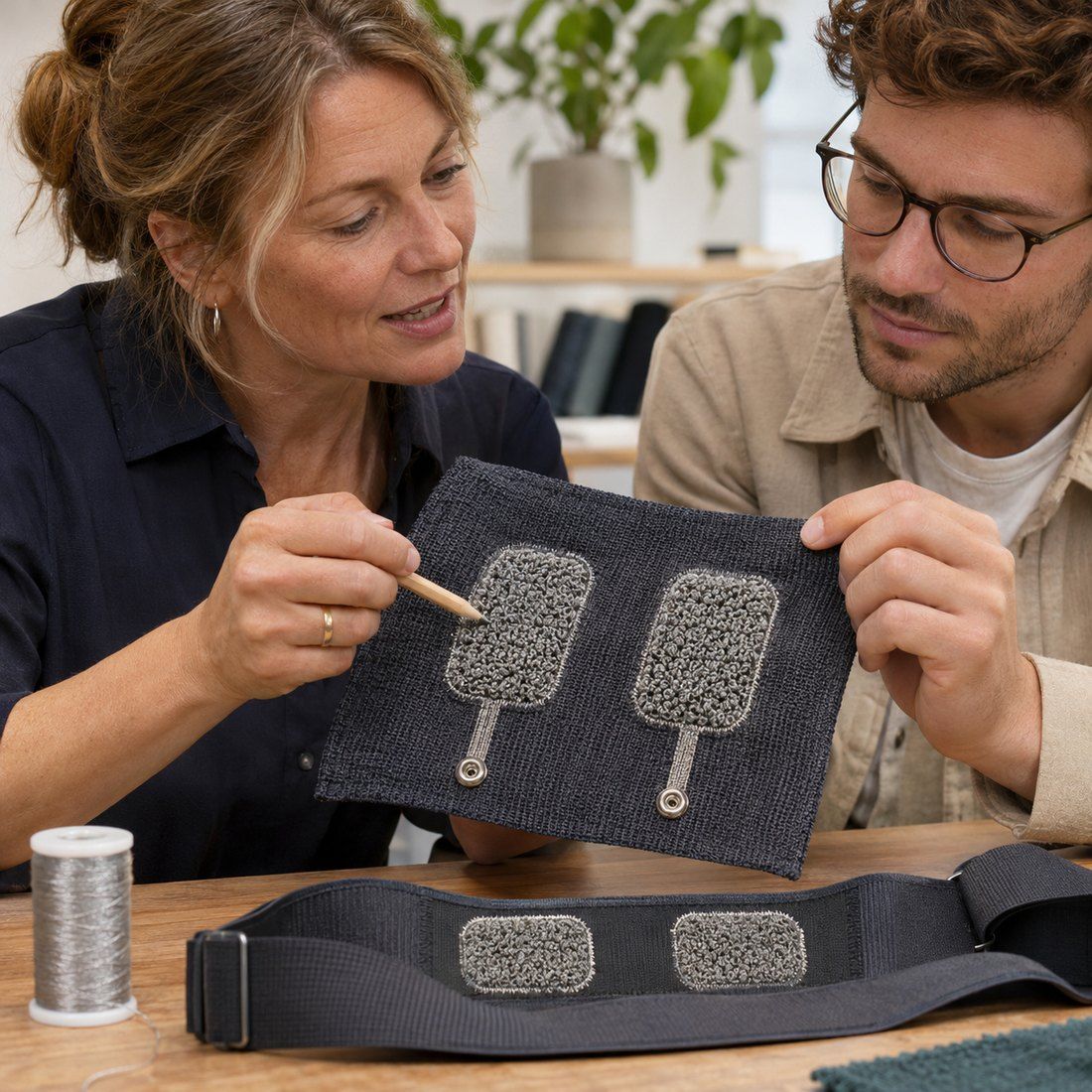
Gel electrodes dry out, can irritate the skin and limit how densely electrodes can be placed. A moss-embroidered electrode solves this with thread: its three-dimensional loops enlarge the contact area and lower the electrode-skin impedance. To make it repeatable you need to know the K-head and its parameters. This course gives you that knowledge, with example settings and sample series for every parameter.
Your course creator
This course was created by Melanie Hörr of 3E Smart Solutions, the ZSK partner for the development of smart textiles, prototyping, workshops and training.
What is a moss-embroidered electrode?
An electrode made of conductive thread. The K-head pulls thread loops through the fabric; the loops stand up as a dense pile, spread against the skin and pick up or deliver the signal. No gel and no adhesive are needed.
Which parameters matter for moss stitch?
Four: stitch length, needle height, presser foot height and thread tension. A shorter stitch length gives a denser pile, a higher needle height gives taller loops. The course shows example values and sample series for each.
What are textile electrodes used for?
For measuring body signals such as ECG, EEG and EMG, and for electrostimulation such as TENS and EMS, in medical textiles, workwear, sport and rehab.
My loops are too small. What can I do?
Lower the thread tension or raise the needle height, and lower the presser foot for firmer clamping. Lesson 7 is a complete fault finder for moss and chain stitch.
How well do embroidered electrodes survive washing?
In a published wash study, electrodes embroidered with silver-coated thread kept their resistance within 1.3 times the start value after 50 wash cycles at 40 °C, and the ECG signal stayed detectable. Copper-coated materials failed much earlier. Lesson 9 sums up what research shows on stitch type, density, contact pressure and washing.
Do I need a machine with a K-head?
For your own samples yes. The principle, the parameters and the design rules can be learned without a machine, which makes the course a good preparation before a machine, a project or a training.
What is included for 499 €?
9 video lessons, a 19-page course handout as a PDF with all tables and settings, and a final test with 34 questions (pass mark 70 %).
What is in this course
1 · Video lessons: from the K-head to the finished electrode
The course handout as a PDF, then nine lessons: why textile electrodes, the K-head principle, moss and chain stitch parameters, yarn supply, inserts and hook needles, designing an electrode with its connection area, fault finder, applications and series production, and what research shows on stitch type, density, contact pressure and washing.
2 · Final test
34 questions on all lessons.
Read more
K-Head: the embroidery head for chenille (brochure, PDF)
ZSK Technical Embroidery Systems (catalog, PDF)
A guide to technical embroidery (whitepaper, PDF)
More smart-textile courses
E-Textiles with the F-Head: conductive threads, LEDs and circuit boards
Embroidering with Wires on the W-Head: heating and sensing with laid wires
Have a project in mind?
3E Smart Solutions supports you with development, prototyping, workshops and training.
Prefer to learn in person?
See the on-site training at your machine.
Copyright © 2026 ZSK Stickmaschinen GmbH