
E-Textiles with the F-Head
Electronics that are part of the textile. Learn how to embroider conductive tracks, touch buttons and sliders, how to place LED sequins, chips and circuit boards automatically, and how to protect and check the finished circuit. With a printable handout and a final test.
-
9 lessons
Video training -
24 minutes
Total video time -
34 questions
Final test, pass mark 70 % -
499 €
One-time payment

Your trainer
Melanie Hörr
Co-Founder & Lead Development Engineer · 3E Smart Solutions
From embroidery to electronics
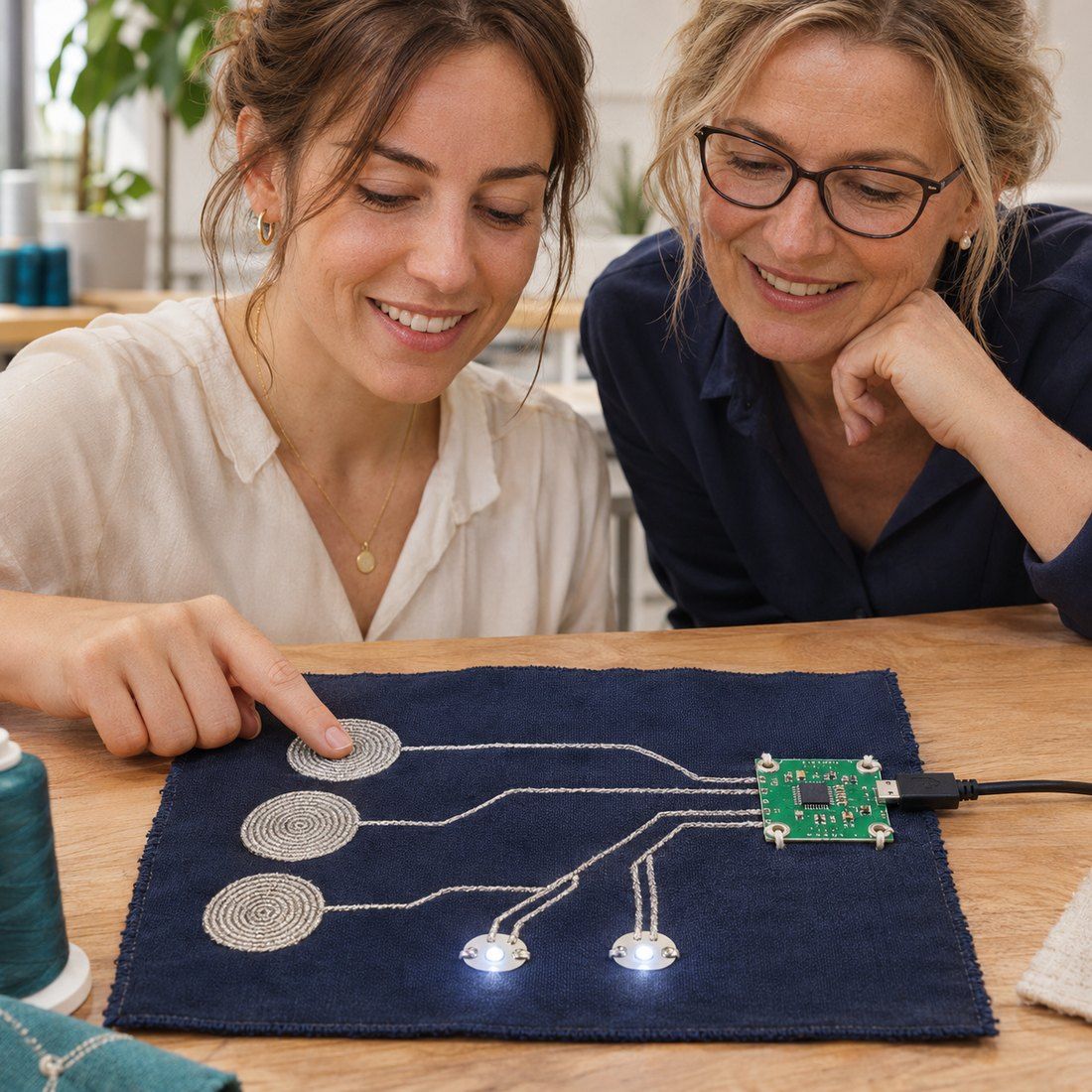
An e-textile carries its tracks, lights, sensors and chips in the fabric itself. The embroidery machine places them exactly, automatically and the same way every time. What you need is the knowledge of which stitch does which electrical job, how components get onto the fabric and how to prove that the circuit works. This course gives you that knowledge.
Your course creator
This course was created by Melanie Hörr of 3E Smart Solutions, the ZSK partner for the development of smart textiles, prototyping, workshops and training.
Three design rules for conductive thread, at a glance
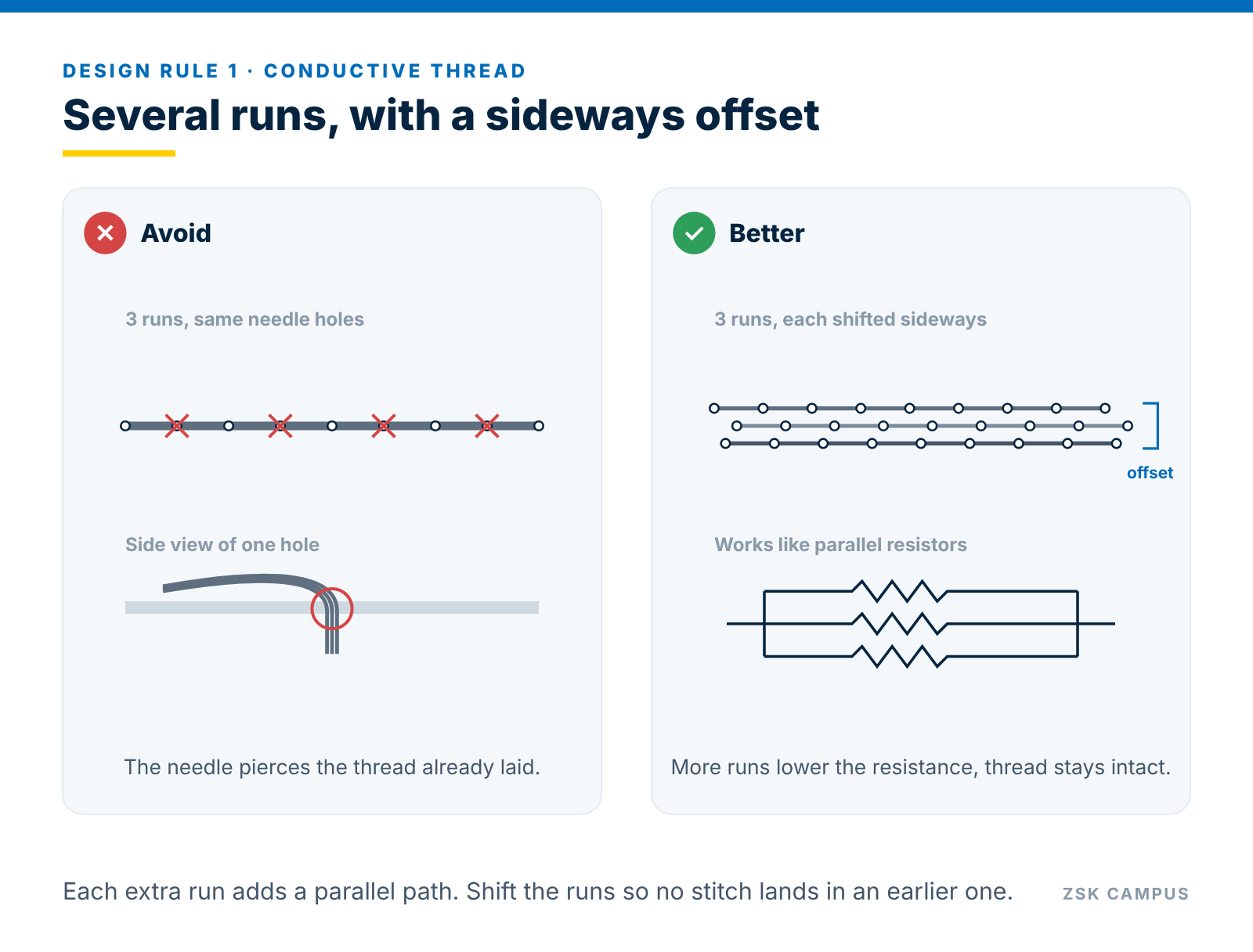
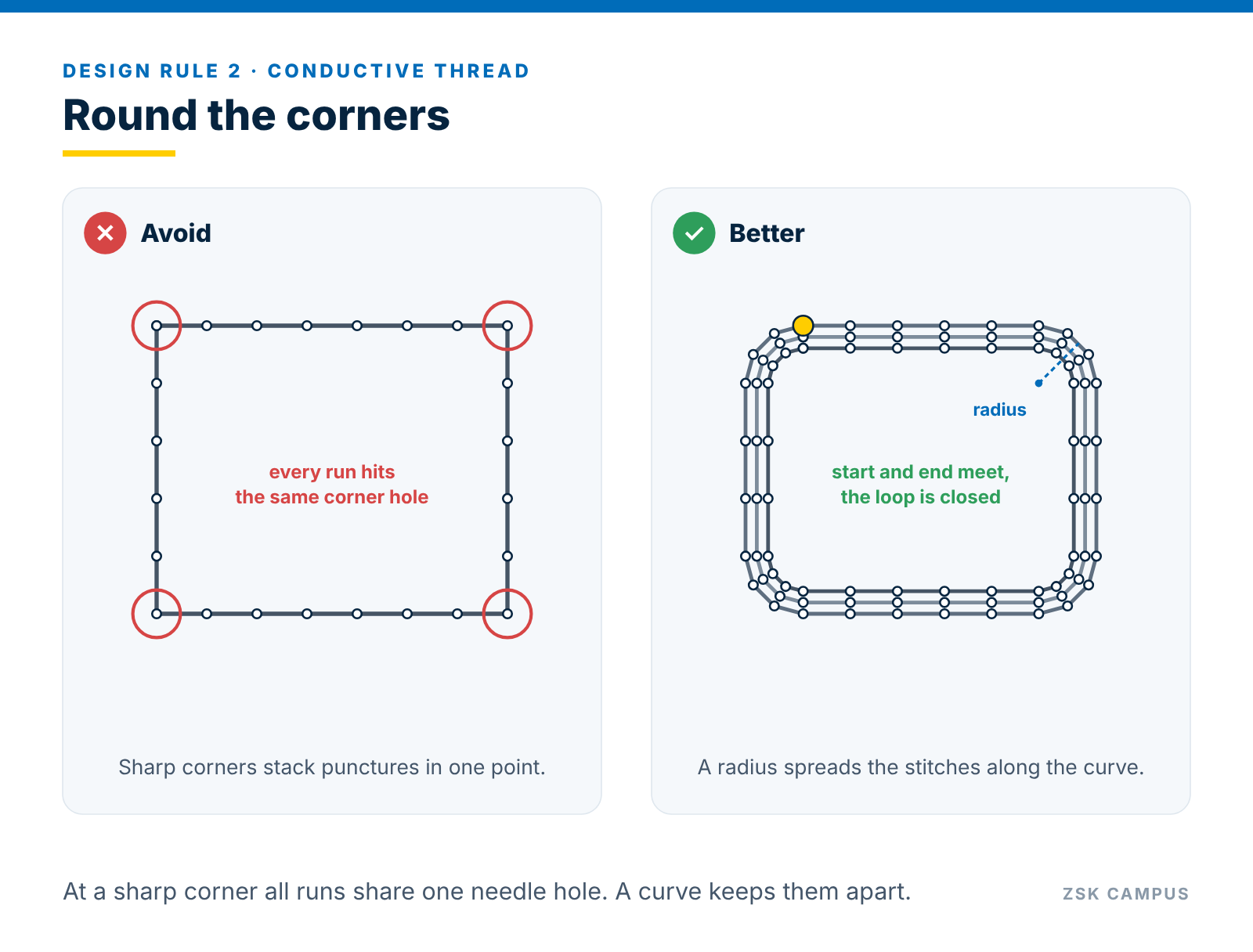
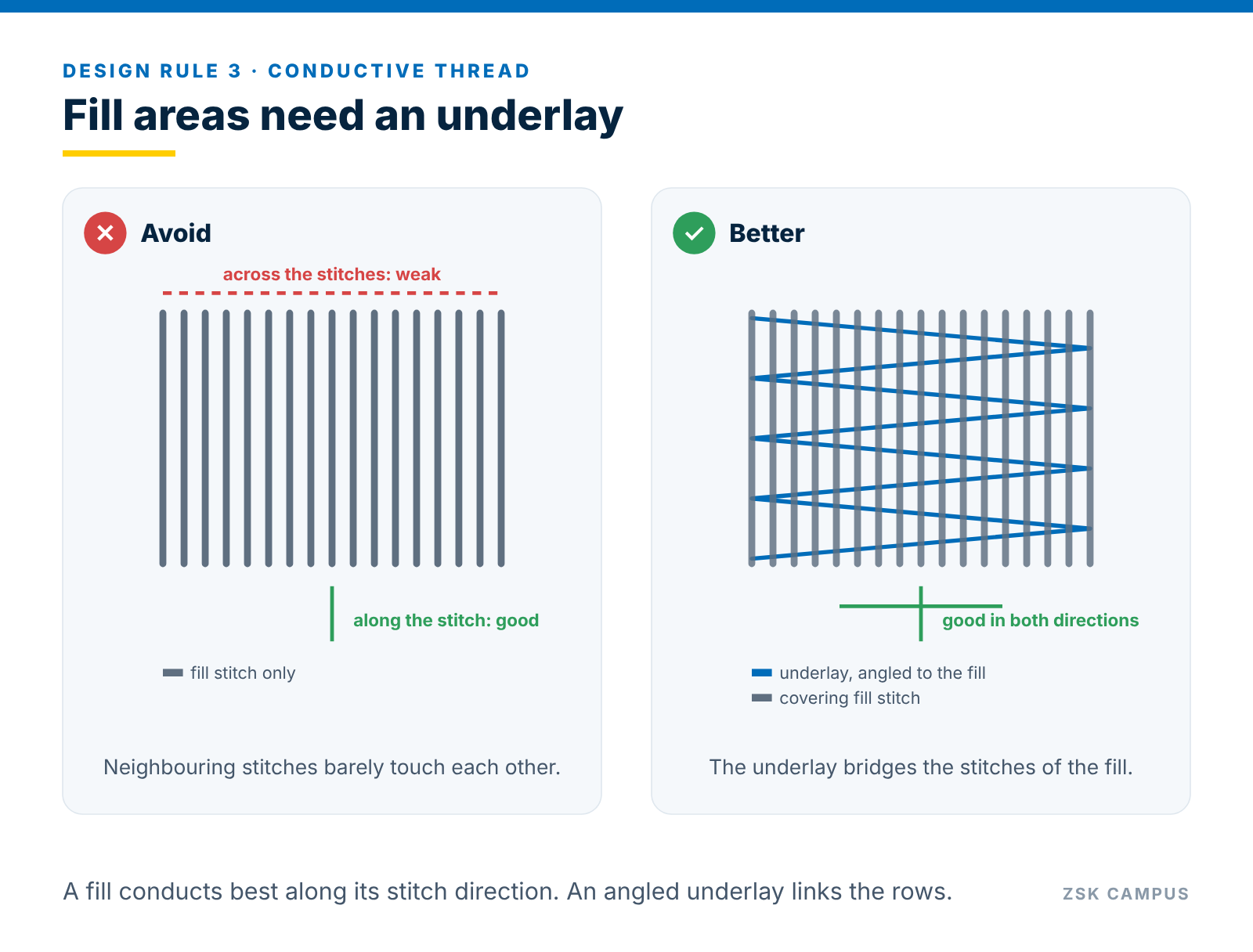
A conductive thread is not a decorative thread: every needle penetration through thread that is already laid can damage it. Three rules from the course keep the resistance low and the track intact.
What is an e-textile?
A textile with built-in electrical functions: conductive paths, LEDs, sensors, antennas or a controller, integrated by embroidery instead of being attached afterwards.
Which conductive thread should I use?
The most common are silver-coated polyamide threads such as Madeira HC 40 or Amann Silver-tech, and stainless steel hybrid threads such as Amann Steel-tech. Their resistance ranges from under 100 to about 500 Ω per metre. Lesson 2 compares six threads that have proven themselves on multi-head machines.
What are the design rules for conductive embroidery?
Do not stitch through conductive thread, use several runs with a swing to lower the resistance, round the corners, put an angled underlay under conductive fills and keep enough distance between tracks. Lesson 3 explains each rule.
Which stitch is used for a conductive track?
A running stitch with conductive thread connects two points. Its conductivity changes with stitch distance, swing and thread tension. Comfort fills form touch buttons and sliders, satin stitches cover and protect.
How are LEDs placed by an embroidery machine?
As LED sequins from a roll, with the Function Sequin Device on the F-head. The conductive thread fixes the sequin and is the electrical contact at the same time, so no soldering is needed.
How do I connect a circuit board to fabric?
With conductive thread. The PCB Placement Device places a board from a magazine, fixes it with thread and needle and embroiders the connections automatically. The standard board size is 30 × 30 mm.
How do I check an embroidered circuit?
Check continuity of every track, exclude short circuits, note the resistance as a reference and test every function under power. Lesson 7 shows the routine and a worked example with Ohm's law.
What is included for 499 €?
9 video lessons, a 22-page course handout as a PDF with all tables and overviews, and a final test with 34 questions (pass mark 70 %).
Your course creator
This course was created by Melanie Hörr of 3E Smart Solutions, the ZSK partner for the development of smart textiles, prototyping, workshops and training.
Three design rules for conductive thread, at a glance
A conductive thread is not a decorative thread: every needle penetration through thread that is already laid can damage it. Three rules from the course keep the resistance low and the track intact.
What is an e-textile?
A textile with built-in electrical functions: conductive paths, LEDs, sensors, antennas or a controller, integrated by embroidery instead of being attached afterwards.
Which conductive thread should I use?
The most common are silver-coated polyamide threads such as Madeira HC 40 or Amann Silver-tech, and stainless steel hybrid threads such as Amann Steel-tech. Their resistance ranges from under 100 to about 500 Ω per metre. Lesson 2 compares six threads that have proven themselves on multi-head machines.
What are the design rules for conductive embroidery?
Do not stitch through conductive thread, use several runs with a swing to lower the resistance, round the corners, put an angled underlay under conductive fills and keep enough distance between tracks. Lesson 3 explains each rule.
Which stitch is used for a conductive track?
A running stitch with conductive thread connects two points. Its conductivity changes with stitch distance, swing and thread tension. Comfort fills form touch buttons and sliders, satin stitches cover and protect.
How are LEDs placed by an embroidery machine?
As LED sequins from a roll, with the Function Sequin Device on the F-head. The conductive thread fixes the sequin and is the electrical contact at the same time, so no soldering is needed.
How do I connect a circuit board to fabric?
With conductive thread. The PCB Placement Device places a board from a magazine, fixes it with thread and needle and embroiders the connections automatically. The standard board size is 30 × 30 mm.
How do I check an embroidered circuit?
Check continuity of every track, exclude short circuits, note the resistance as a reference and test every function under power. Lesson 7 shows the routine and a worked example with Ohm's law.
What is included for 499 €?
9 video lessons, a 22-page course handout as a PDF with all tables and overviews, and a final test with 34 questions (pass mark 70 %).
What is in this course
1 · Start here
The course handout as a PDF, to read along and to keep at the machine.
2 · Threads, stitches and components
What e-textiles are and what the F-head does, conductive threads and their requirements, five design rules for conductive embroidery, stitch types with an electrical function, LED sequins and the Function Sequin Device.
3 · Boards, sensors, checking and workflow
PCB placement and the E-Tex board, sensors, antennas and wires, protecting and checking the circuit, workflow and the way to series production.
4 · Final test
34 questions on all lessons, including two short calculations.
Read more
ZSK Technical Embroidery Systems (catalog, PDF)
A guide to technical embroidery (whitepaper, PDF)
Technical Embroidery: the ZSK magazine (PDF)
More smart-textile courses
Textile Electrodes with the K-Head: moss and chain stitch for body signals
Embroidering with Wires on the W-Head: heating and sensing with laid wires
Have a project in mind?
3E Smart Solutions supports you with development, prototyping, workshops and training.
Prefer to learn in person?
See the on-site training at your machine.
Copyright © 2026 ZSK Stickmaschinen GmbH