
Embroidering with Wires on the W-Head
The complete training for Tailored Wire Placement: how the W-head lays and fixes a wire, which wire fits your application, how to set up the machine, digitize the layout and calculate length and resistance. With the training handout, a final test and worked solutions.
-
13 lessons
Video training -
37 minutes
Total video time -
33 questions
Final test with calculations -
499 €
One-time payment

Your trainer
Melanie Hörr
Co-Founder & Lead Development Engineer · 3E Smart Solutions
Wire know-how that turns samples into products
Heating elements, sensors, LED lines and antennas all start with a wire that lies exactly where the design says and keeps its resistance. That takes knowledge of the machine, the material and the electrical design. This course gives you all three, step by step, with the numbers and settings from the ZSK and 3E Smart Solutions W-head training.
Your course creator
This course was created by Melanie Hörr of 3E Smart Solutions, the ZSK partner for the development of smart textiles, prototyping, workshops and training.
What is Tailored Wire Placement?
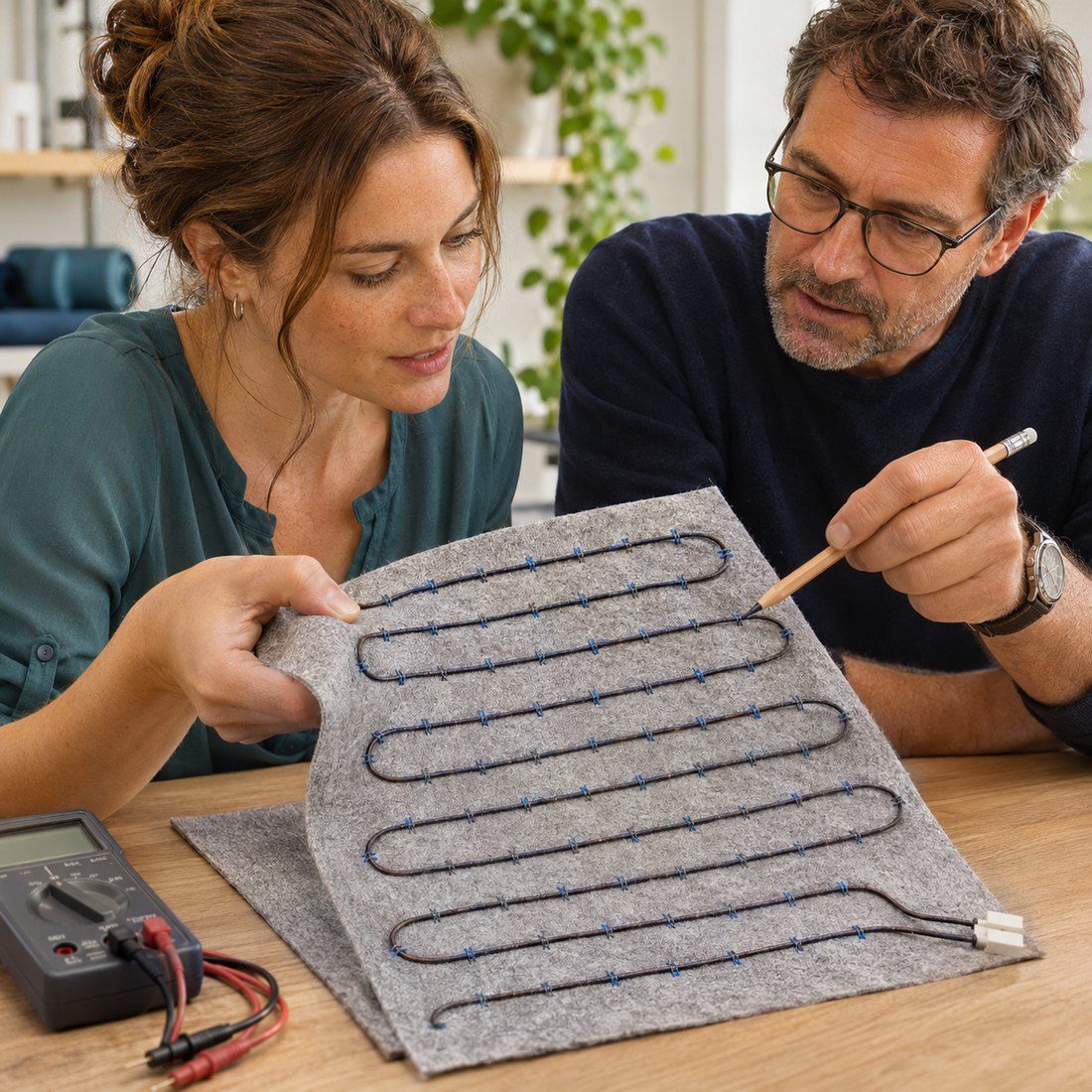
The W-head lays a wire on a textile carrier and fixes it with a zigzag stitch. The needle stitches to the left and right of the wire and does not pierce it. The layout is free, repeatable and scalable from one sample to series production.
Which wires can the W-head lay?
Wires from about 0.07 mm to 6 mm in diameter: stranded copper wire, stainless steel wire, insulated heating wire and LED wire. The course shows which wire suits heating, sensing or lighting and which laying foot belongs to it.
How do I calculate the wire length for a heating element?
First the target resistance: R = U² / P. Then the length: L = R / R′, with R′ as the resistance per metre from the spool label. Example: 10 W at 5 V needs 2.5 Ω. With a wire of 4.439 Ω/m that is 0.56 m.
Why does my measured resistance differ from the calculation?
Most often because of the measuring leads. A lead resistance of 0.3 Ω is a large error on a heater with 0.5 Ω. Subtract it or use the REL function of the multimeter. Lesson 3 and the final test train exactly this.
Do I need a machine with a W-head?
For the practical exercises yes. The theory, the electrical design and all calculations can be followed without a machine, which makes the course a good preparation before a machine or a training arrives.
What is included for 499 €?
13 video lessons, the complete training handout as a PDF, a final test with 33 questions and calculation exercises (pass mark 70 %), the worked solutions and two bonus lessons on the smart-textiles toolbox and on series production.
What is in this course
1 · Start here
The training handout as a PDF, to read along and to keep at the machine.
2 · The W-head and its materials
Principle, laying materials and the starter kit, measuring, LED wire and stretch designs.
3 · Machine setup, digitizing and electrical design
Supply, laying feet and T8 settings, digitizing for wire, resistance, power and parallel paths.
4 · Contacting, further techniques and quality
Contacting, insulating and protecting, coiling and combining media, do's and don'ts, testing.
5 · Test and worked solutions
Final test, then every exercise explained step by step.
6 · Bonus: smart textiles beyond the wire
W-, F- and K-head compared, and the way from a sample to series production.
Read more
TWP & TTP: Functionality in Textiles (ZSK catalog, PDF)
W-Head: the embroidery head allrounder (brochure, PDF)
ZSK Technical Embroidery Systems (catalog, PDF)
More smart-textile courses
E-Textiles with the F-Head: conductive threads, LEDs and circuit boards
Textile Electrodes with the K-Head: moss and chain stitch for body signals
Have a project in mind?
3E Smart Solutions supports you with development, prototyping, workshops and training.
Prefer to learn in person?
See the on-site training at your machine.
Copyright © 2026 ZSK Stickmaschinen GmbH